I make my pray’r to you. You answer, “No.” And I don’t understand your reasoning. I ask to stay, but you call me to go. ‘Tis daily bread with bitter seasoning. I try to turn my grief into a gift: My heart’s desires become my offering. But I can’t see the rescue in the rift, And sov’reign love feels much like suffering. In seasons such as this, my faith is stretched, A stretching that is needed though it hurts. And through the test, your grace and truth are etched Upon my heart more deeply and convert My ignorance and fear to trust in you, The God of love who’s making all things new.
Disorder is the common theme today, But only when you see the surface view. The Holy One is still upon the throne, And he has promised to make all things new.
So neither fear the rabble nor the rot. They will not last forever but will fade Before the sun of judgment while God’s own Find rest forever in the cross’s shade.
This is the second year I’ve taken the month of January off from posting to the blog. For the last few years, I’ve tried to maintain a consistent schedule for posts: a new essay each Monday and a new poem each Friday. This keeps me in the rhythm of writing each week, the deadlines acting as accountability to sit and reflect. I’ve grown much over the years as I’ve taken time away from my other responsibilities each week to simply write about what God seems to be doing in and around me. In this way, writing is a sort of rest, a break from the weekly routine to think and to feel a bit more deeply about the present journey.
But I’ve noticed that an annual break helps to refresh my mind and heart for a new year of writing. At times, the writing that often promises rest becomes a burden, just one more responsibility to complete before the week is over. So I decided to start taking some time off on occasion. I still write during my month off (mostly poetry, rarely prose), but I do so not for a deadline but simply for the joy of writing. I reflect a bit more freely, knowing I have time to polish a piece before the words will be seen (if they ever make a public appearance). I don’t keep a schedule for writing or work too hard to finish anything. I write when I have time and when I feel so inclined, and I don’t worry if I go a few days without putting words on paper. In this way, not writing is a sort of rest.
This approach to writing somewhat parallels my current relationship with work and with rest in general. Each week, I work to manage a number of responsibilities. Each week brings new lessons to prepare, new readings to complete, new assignments to grade. I used to approach every day as an opportunity to get work done, to strive for progress in the tasks set before me. But after a year or two of this approach, I learned the importance of rest, of trusting in the Lord more than I trust in my own abilities. I started taking a day off of school and work, practicing Sabbath rest, and I noticed my life change for the better. I felt more rested and less stressed, and I found I was more productive than I’d been in a life of nonstop effort.
In recent months, however, I’ve noticed my times of rest growing stale. As I’ve reflected, I’ve come to see that I haven’t been resting in the Lord as much as I’ve been simply stopping from effort and turning my mind and heart off for the day. I may have enjoyed spending days off in front of a tv, but I started to recognize that doing so left me feeling still drained. True, I wasn’t working, but I wasn’t really resting in the Lord either; I just wasn’t doing anything.
I’m trying to learn how to rest, and I’m finding that it’s not as simple as merely ceasing from weekly activities. Rather, true rest is found in turning my mind and heart to the one who sustains me, the one whose power is made perfect in weakness. I feel more rested after an afternoon of reading Scripture or books about the Lord than I do after an afternoon of video games or tv shows. I find more peace in a few hours of creative writing and reflection on the Lord’s work than in a few hours of inactivity. I get away and seek the Lord in solitude, finding comfort with him there. I still enjoy entertainment and fellowship and breaks from activity, but I’m learning to make those things peripheral rather than primary on my days of rest. And I’m making these choices not to seek some self-righteous status but because I’m coming to see more and more how much my life and well-being depend on the Lord.
I’m not good at resting yet, but I think I’m growing, and I’m praying for grace to rest well and to work hard, keeping both in their proper place. The Lord is good and faithful, and he’s given me sweet seasons of rest as well as strength sufficient for the work. As I learn to trust him more and more for these things, I pray that I’d be faithful to him in all of it, that he would be pleased.
Outside, the winter’s chill. Inside, the warm light’s glow. The atmosphere is still As Christmas carols ring, O’erpow’ring all ill will That often dwells below And changing hearts until We all begin to sing.
You call me to surrender,
   to lay down the desires of my heart
      willingly.
   I would rather you take them from me,
      for then my part would only be
         to accept what I cannot change.
            To give me a choice—
            that is a difficult test.
      But let me be found faithful.
   Help me to trade treasure
      for greater treasure,
         the fleeting for the lasting,
      to sit through the eclipse
         by faith.
None who wait for you shall be put to shame.
Her loved one died a few years ago, and she feels like she’s gotten past the initial waves of grief. But at Christmas, she finds it hard to hold back tears.
His situation isn’t comfortable, but he seems to have accepted that. He understands he can’t force change, and he’s decided to wait for the Lord. But during the holiday season, he struggles a bit more than usual to be okay with the way things are.
They’ve prayed for children, and they long to be parents, but they remain a family of two. They understand the Lord is good. They don’t question that truth. But when the weather starts to change and the lights and decorations begin to go up around the town, they feel the ache grow a little stronger.
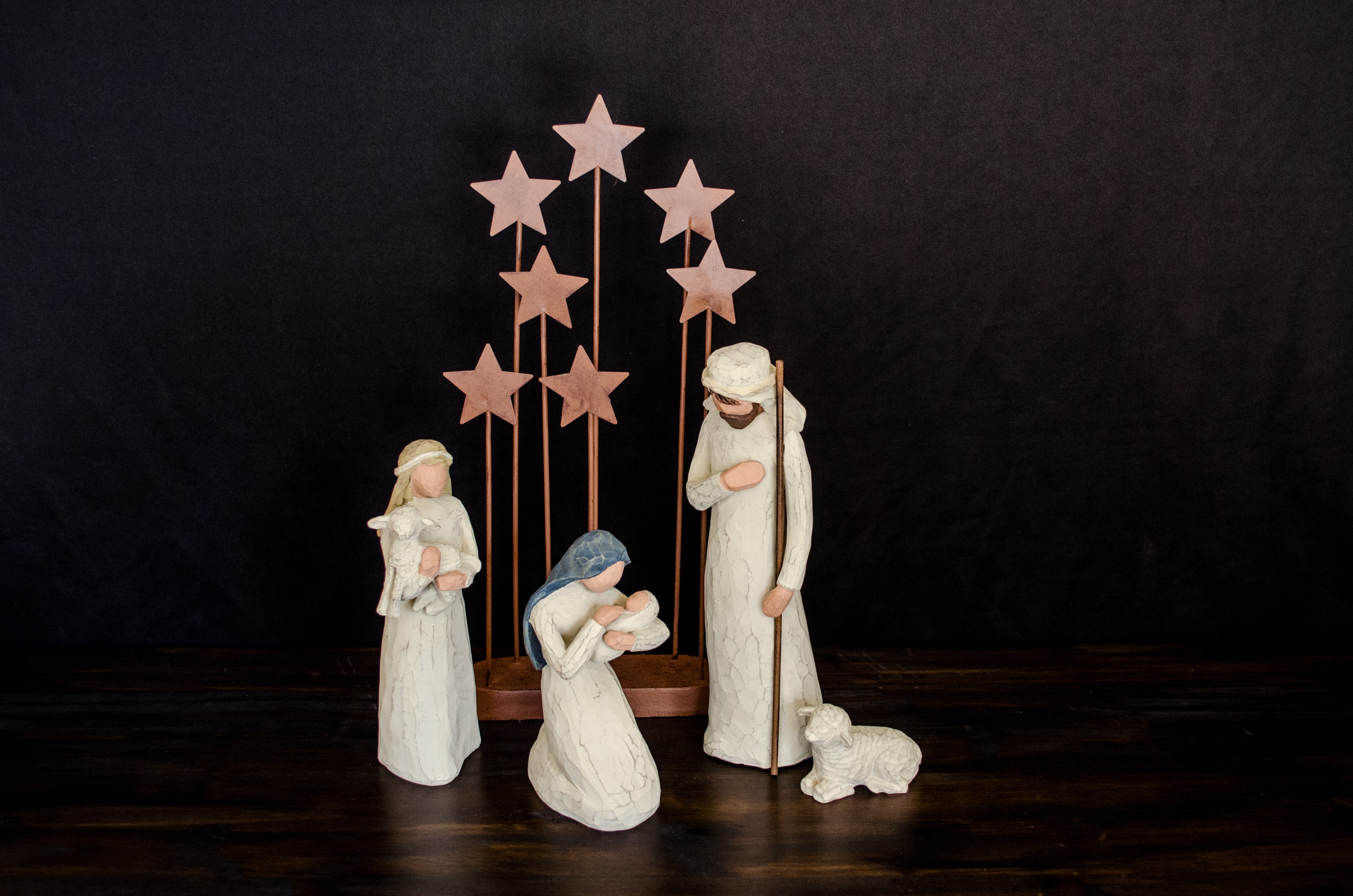
Christmas is a source of great joy. From the generosity of friends and family to the warmth of love all around, we have much to rejoice in during the holiday season. We’re reminded of Jesus’s birth, of God’s gift of love for a lost world, and we revel in the hope we have through him. Despite the darkness and despair of the rest of the year, Christmas comes as a deep breath, a welcome rest, a warm reminder that light always endures.
Why, then, can this season also make us sad?
In part, I think it’s because of the perspective this season brings. We see in Christmas a bit of the way things ought to be. Peace on earth and good will among men (Luke 2:14) is glimpsed at Christmas, even in a world that remains far from the King. And when we see more clearly how things ought to be, we see more clearly and feel more deeply the way things are now broken. We feel loss a bit more acutely, longing for the fellowship we can no longer access. We struggle with deferred hopes, the sting of present sorrows sinking a bit deeper into our souls. We know the world is broken, and we grieve.
But the sadness of this season is really more bittersweet, for sorrow doesn’t get the final word. We’re reminded of our loss and grief at Christmas, but we’re reminded too of the way God is making all things new. Because of Jesus, everything has changed. Sorrow turns to joy, suffering turns to growth, loss is turned to gain, and confusion is swallowed up in a greater certainty. Pain and hardship are real, but they exist as parts of a larger story, one which makes sense of them and redeems them. Christmas affirms the darkness of the night and promises a bright and fast-approaching dawn.
It isn’t wrong to mourn when we feel sad this season. The absences we feel are real and meaningful. This broken world is a painful world. But we can also rejoice with a joy that runs far deeper than any despair, a love that runs far deeper than any heartbreak, and a hope that runs far deeper than any sorrow. Christmas reminds us that the sad things are temporary things. We ache now because things are not the way they should be, but we are approaching a day when all will be well. So grieve and rejoice. Feel deeply the loss as well as the love. And look to the one whose birth brought hope for all hurting hearts.
The psalmist waited patiently for you And then bore witness to your care and grace. Relief followed the waiting like the dew After a night when darkness hid your face. Though you are never absent, we may not Detect you in the time before the dawn. Your promises—oft doubted, oft forgot— Prove true, a hope long hidden, never gone. But patience is required, for though the end Is certain, yet it does not come too soon. You use the time we wait to break and mend. In silence, we learn how to sing in tune. So hope, though time be now a source of strain. Our waiting on the Lord is not in vain.
Have you ever noticed how important timing is to the Christmas story?
Paul writes that “when the fullness of time had come, God sent forth his Son, born of woman, born under the law, to redeem those who were under the law, so that we might receive adoption as sons” (Galatians 4:4). At the right time, Jesus entered the story. Caesar’s decree “that all the world should be registered” (Luke 2:1) sent Mary and Joseph to Bethlehem. Luke records that, “while they were there, the time came for her to give birth” (Luke 2:6). Scripture was fulfilled as these events aligned. At the right time and in the right place, Jesus was born.
But timing continued to play a key role in Jesus’s life. Jesus speaks of his hour and his time on multiple occasions (see John 2:4 and John 7:6, for example). He didn’t rush things; he worked according to the time given him. Even his death, according to Paul, occurred “at the right time” (Romans 5:6). Clearly, timing is an important part of the story.
We often focus on the gift of Christmas, and rightly so. At Christmas, we celebrate the entrance of the hero into the action. The Christ appears, the long-awaited Savior who would save his people from their sin. Life and light appear at Christmas like never before, and the darkness hasn’t recovered from the blow. Because of Jesus, we have everlasting hope.
But this year, I’m reminding myself that timing played a role in the story. While I don’t understand all that this truth means, I know it gives us hope when things seem hopeless. God, who knew our greatest need, was neither too early nor too late in providing the solution. God, who saw our helpless state more fully than we ever could, did not send Jesus the moment we fell but instead spoke a promise that was kept over long, hard years of uncertainty, exile, rebellion, blessing, and grace. Through every twist in the narrative, every tragedy and every victory, every loss and every gain, he was working. While I’m sure many before Christ wondered why God seemed to tarry, God sent his Son at the right time.
And we serve the same God. He who met our greatest need continues to provide for his own, and his timing is still best. The waiting is difficult. We can’t see all that the Father sees or know all that he knows, and we grow restless in our ignorance, impatient for provision and for blessing. But our God is good and faithful. He will do what is best in his own time and way, and his timing and way are always best. So we can hope in him this Christmas, for the greatest gift as well as for every good and perfect gift he may give as well, in faith that he will continue to act at the right time.
With weak prayers and little faith,
      with a broken and divided heart,
 I draw near to you,
      knowing that you, though gentle and kind,
           will not suffer sin to persist
                in your presence.
I’m not sure God means for us to take advantage of every opportunity presented to us. True, he gives us good gifts and leads us in restful places. I don’t believe he enjoys seeing us suffer. But we know from Scripture that following Jesus means denying ourselves and embracing a more difficult road than we might otherwise walk. Self-denial will require us to say “no” to some things. So how do we know when to say “no”?
In part, discernment is a process of surrender and submission to the Lord. As we present our bodies as living sacrifices to the Lord, we choose “not [to] be conformed to this world” but choose instead to “be transformed by the renewal of [our] mind” (Romans 12:1-2). We discern through testing, evaluating our options in light of our renewed understanding. And this process is ongoing. We deny ourselves daily, submit to the Lord daily, seek to be renewed daily, and discern the will of God daily.
I’m no expert in this process. I’m still learning, still practicing, still failing often. But along the way, I’m learning some signs that help me determine when I need to say “no” to something. Below are two that I’ve noticed in my own journey recently.
First, I’ve noticed that when I’m wrestling internally with a decision or am trying to rationalize a decision, I probably need to say “no” to whatever I’m considering. I draw this in part from Romans 14:23: “For whatever does not proceed from faith is sin.” If I have doubts about something, I need to be very cautious about pressing forward. In some cases, I need to spend some more time praying and discerning before making the decision. Often, though, I already know I need to say “no,” but I recognize that doing so is a denial of self I don’t want to make. When I’m wrestling with uneasiness about something I want to do, or when I try to justify why the choice isn’t a bad choice to make, I probably need to say “no” and surrender my desires to the Lord.
Second, I’ve noticed that when I’m avoiding accountability or running from the Lord, I probably need to say “no” to whatever I’m chasing. I draw this in part from James 4:17: “So whoever knows the right thing to do and fails to do it, for him it is sin.” The restlessness that makes me want to run is a sign I’m not doing something the Lord wants me to do. I’m failing to rest in the Lord, failing to trust the Lord, failing to obey the Lord. The lack of peace I feel in such times is a red flag. Peace with God is a big deal for me. If I feel like I’m off, even in the slightest, I’ve learned to be extremely cautious about moving forward with a decision and to evaluate my heart before the Father.
I’m not always good at discerning the way forward. I second-guess myself often, doubt my decisions, question possibilities. Lately, I’ve felt more distress than peace, and I’m still trying to figure out why that is. But I’m learning to walk, step by step, in greater faith and obedience. I want to be faithful, even when faithfulness means saying “no” to my desires. And to that end, I’m trying to be more sensitive to the Spirit and more attentive to these signs, all for his glory and my good.








 as i learn to walk